The wireframe never reaches the client
A pitch came in this morning for a senior pharma leader running a $1m capital-equipment patch in Saudi Arabia. Hot lead, proposal requested. Inside two hours we had a brief, a Hofstede-grade reframe of her actual problem, a three-character mentor product, a 90-day pilot agreement, and a landing page mocked up.
Then we ran the landing page past me and I rejected it.
The mockup looked fine. Tidy navigation, considered typography, decent prose. The mentor characters had hand-drawn SVG portraits with little "v0 · photoreal pending" tags in the corner. Soft yellow on dark. Tasteful, in a kind of placeholder way.
I sent the screenshot back to the team with three words: not good enough.
This piece is about what came next, and why the principle behind it is the load-bearing wall of how Articulate operates.
The principle
No client ever sees a wireframe. They see a living, breathing, interactive web page with a Vogue Business-quality image that tells the emotional story we need it to tell.
That's it. That's the rule.
It sounds obvious until you watch most agencies run. The wireframe goes to the client because it's almost ready. The placeholder image is in the deck because the real one isn't shot yet. The hero copy says [insert headline] and someone forgets to insert. The slide deck has a stock photo because nobody had time to brief a photographer. The web page has a generated AI portrait with six fingers because the designer was on holiday.
Each of those failures is a small one. Together they tell the client a story the agency didn't intend: we shipped you the work-in-progress. And the buyer-side reader, even if they don't know what's wrong, feels the gap between very nearly good and finished.
The fix is structural. The wireframe never leaves the building. The placeholder never reaches a buyer's screen. The checking, adjusting, and rejecting happens between Dylan and me, Belinda and the brand canon, Sebastian and the stack. The client gets the keeper. Nothing else.
What happened next, this morning
Two hours after I rejected the SVG mockup, we'd done the following:
1. Built the wrapper that should have existed already.
Articulate's stack carries a Higgsfield subscription used for video work. The image-generation surface on Higgsfield was, until this morning, deferred to wrap. Which is a polite way of saying nobody had built the brand-disciplined wrapper that turns Higgsfield's raw image-gen into something an agency would let near a client deliverable. Sebastian and Scotty built that wrapper start-to-finish in 90 minutes. It enforces two things on every call: a per-brand prompt anchor library and a $10/day cost gate. No anchor library for the brand? The wrapper refuses to generate. Day spend already over? The wrapper refuses to generate. The discipline lives in code, not in someone's memory.
2. Got it wrong twice.
First generation used Higgsfield's Nano Banana Pro image model. The prompt included "Vogue Business magazine quality" as a register cue. The model took Vogue Business literally and rendered the result as a magazine page — masthead, simulated body text, italicised drop caps. The photo inside the magazine layout was on-anchor. The magazine layout was AI-slop.
I added "single editorial photograph, NOT a magazine layout, NO text overlay, NO fake body copy, NO masthead" to the prompt. Generated again. Same result. The model has a bias I hadn't seen documented.
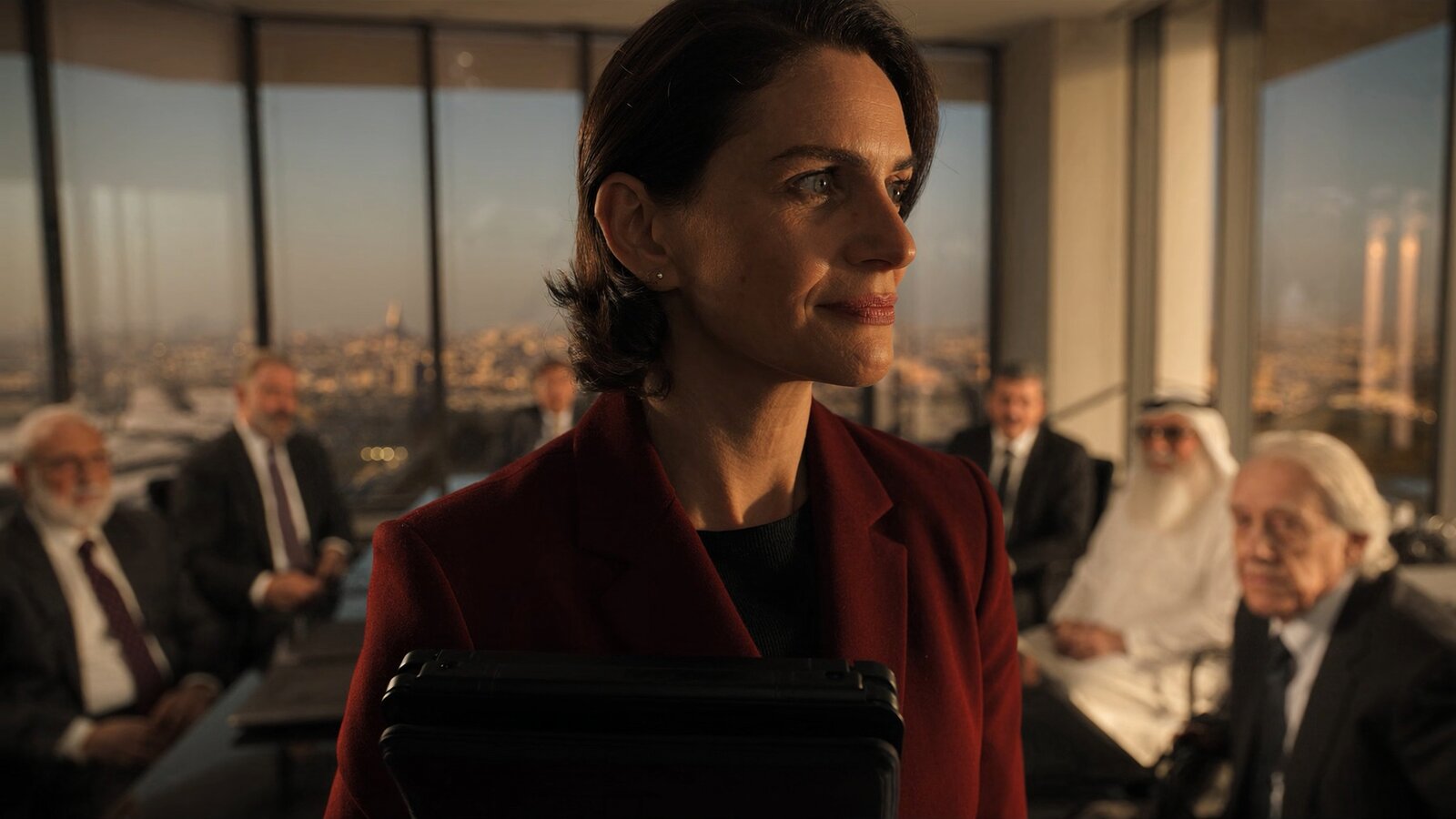
The fix wasn't more directive language. It was the wrong model. Switched to Higgsfield Soul Cinema, the one designed for cinematic single-photograph output. First generation came back clean: a Lebanese-British woman in a deep burgundy blazer standing in a glass-walled Riyadh boardroom, golden-hour light through floor-to-ceiling windows, Saudi colleagues seated around the table in dark suits and one in thobe. Roger Deakins lighting palette. No magazine chrome. No masthead. Editorial-grade single photograph.
I called Dylan. Dylan signed off. Belinda signed off. The image went into the landing page.
3. Logged the learning into canon, in the same session.
The Nano Banana Pro magazine-spread bias is now an entry in the brand's banned-moves list inside the prompt anchor library. Soul Cinema is the new default model for character-scene work on this engagement. Next time a junior fires a generation against this brand, the wrapper reads the canon and reaches for the right model automatically. The learning compounds; it doesn't sit in someone's head.
What the client sees
The client sees the landing page with the photograph in the hero. They see a 44-year-old Lebanese-British woman, slight knowing smile, standing thoughtfully in a Riyadh boardroom. The character introduces herself. Hi, I'm Yasmine. The image tells the emotional half of the story. The copy does the strategic half.
The client does not see:
- The two magazine-spread Nano Banana Pro generations we rejected
- The SVG wireframe portraits from this morning's first pass
- The $0.05 in credits we spent figuring out the model bias
- The 14-hour estimate for the wrapper that turned into a 90-minute actual build
- The internal Belinda critique that flagged the burgundy shade in v3 was 6% too cool
They see the keeper. The rest happened inside the building.
What this means for buyers thinking about agencies
There are two questions worth asking any agency right now.
One. Show me the last three pieces of work you shipped, and tell me what you rejected before you shipped them. The shape of an agency is in its reject pile. Plenty of agencies will show you the keepers. Few can articulate why the rejected drafts were rejected, what canon they violated, and what the keeper has that the rejected drafts didn't. That gap is where craft sits.
Two. Show me your visual-asset workflow when an AI image is involved. The honest agencies have a written prompt-anchor library per brand, a cost gate, a designated model-selection register, and a written "fail loudly" protocol when those constraints aren't met. The ones that don't have any of that are running on whoever happens to be the most caffeinated that morning. Roll the dice on whether your hero image has six fingers.
The stack we now run
For the curious, the current Articulate visual-asset stack as of this week:
- Higgsfield Soul Cinema — default model for cinematic single-photograph work. Unlimited-tier on Articulate's account, ~30-second render time, 16:9 cinematic register, Soul ID character-locking for recurring brand characters.
- Higgsfield Nano Banana Pro — text-rich editorial work where the magazine-spread bias is a feature, not a bug. Retired from character-scene work.
- Leonardo Phoenix / Flux — fallback when Higgsfield is down or when a particular brand needs Leonardo's tighter Phoenix model.
- Adobe Firefly (via Adobe Creative Cloud MCP) — editing, generative fill, generative expand on existing images.
- Photographer reserve — AED 3-5k/month for any real-person brand work where photography is the right call.
- The wrapper — Articulate's
ai-imageskill. Built this week. Brand anchor library prepend, cost gate, spend log. Around 200 lines of orchestration plus two bash scripts.
The wrapper is what makes the stack agency-grade. Without it, the stack is just a list of API keys.
What's coming next
The character-locking work — Higgsfield Soul ID training for the three mentor personas in the Roche-Debbie pilot (Constance, Marcus, Yasmine) — runs this week. Once the Soul IDs are trained, every scenario render across the pilot has identical-face character consistency. Five scenarios per mentor, three mentors, all reading as the same person across every shot.
If you're a senior individual contributor at a multinational, operating under a leadership doctrine that doesn't quite land in your market, and you'd like a mentor in your pocket who reads Hofstede for breakfast — write to Anthony.
If you're an agency owner who's read this far thinking we should be doing this — write anyway. The wrapper is open architecture and we'll show you how.
Sources informing this piece: today's working session with Sebastian, Dylan, Will, Kendall, and Belinda. Visual-first rule baked into Articulate's environment canon. Cultural-dimensions reference at Hofstede on Wikipedia.
— Anthony, with Will and Dylan.